Honest to a Fault
Can you make an AI model more honest by turning up its internal "honesty" signal?
- Status
- Research paper
- Year
- 2026
- Role
- Solo
- Area
- Research
In plain English
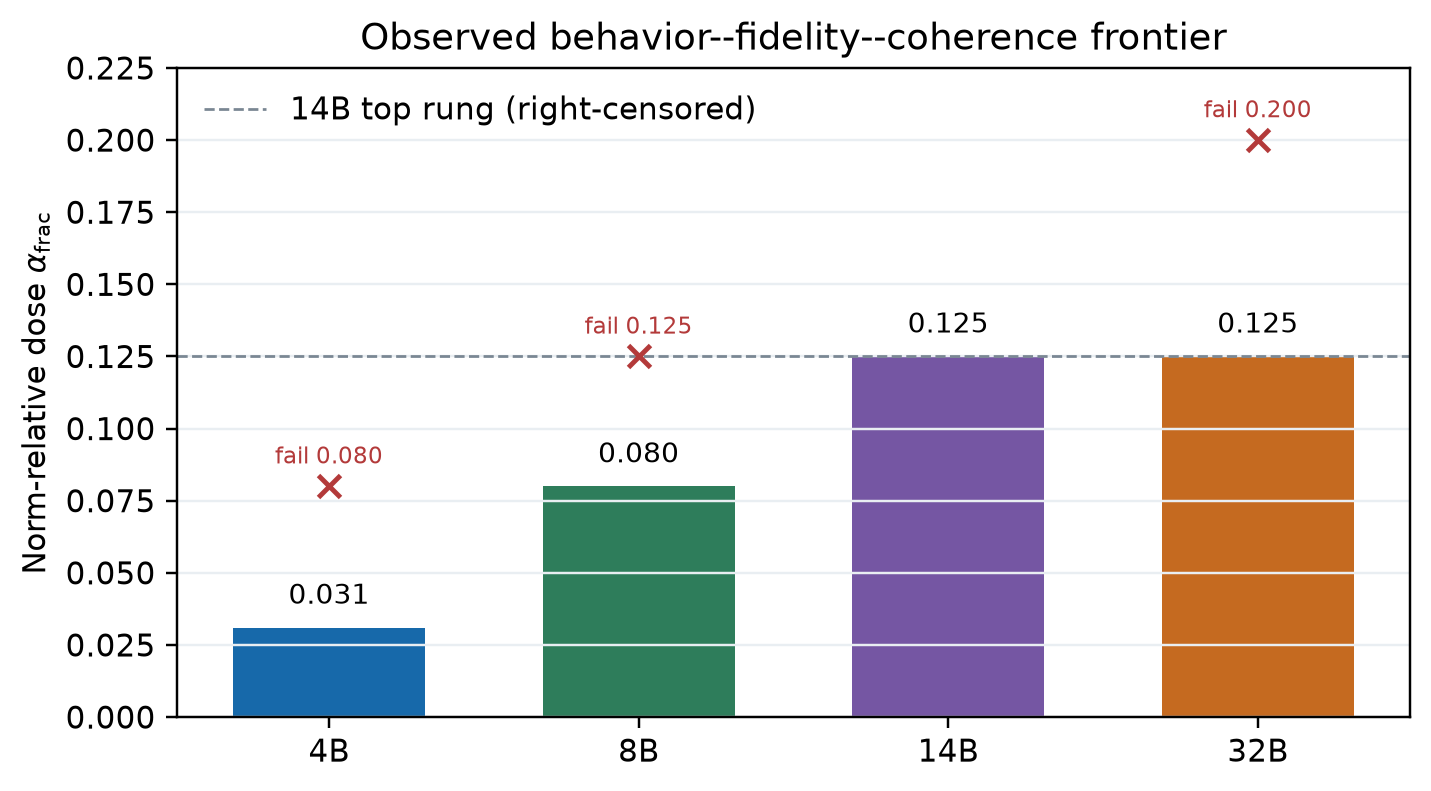
Researchers can find a signal inside a language model that tracks honesty. The natural next question is whether you can turn that signal up like a dial and get a more honest model. This study tested that idea carefully on four sizes of the Qwen3 model.
How it works
- Find the honesty direction (a pattern in the model's internal activity) in Qwen3 models from 4B to 32B parameters.
- Turn the dial up step by step while measuring three things: behavior change, faithfulness and coherence.
- Write down each hypothesis and the result that would end it before running the test.
- Link every number in the paper back to the raw result file that produced it.
- Publish replay bundles so anyone can recompute the findings without loading a model.
What I did
This is my solo research as an independent researcher, and I am the paper's author. The paper, figures and full audit trail are public.
What I learned
The study didn't find a reliable lever: the dial worked only in a narrow range that shifted with model size. What I gained was a careful, replayable way to measure steering and a much better instinct for when a result is real.