Antelligence
Ant-colony teamwork for swarms of tiny robots, tested in simulation and aimed at medicine.
- Status
- Active · collaborative
- Year
- 2025
- Role
- Co-builder with Kashyap Nadendla; one of the original team of four
- Area
- Research
In plain English
Ant colonies coordinate thousands of workers with no boss, using only scent trails and local signals. Antelligence asks whether simple AI agents can coordinate the same way, with the long-term goal of guiding swarms of tiny medical robots. Today it runs in simulation, where a swarm practices finding and targeting a tumor.
How it works
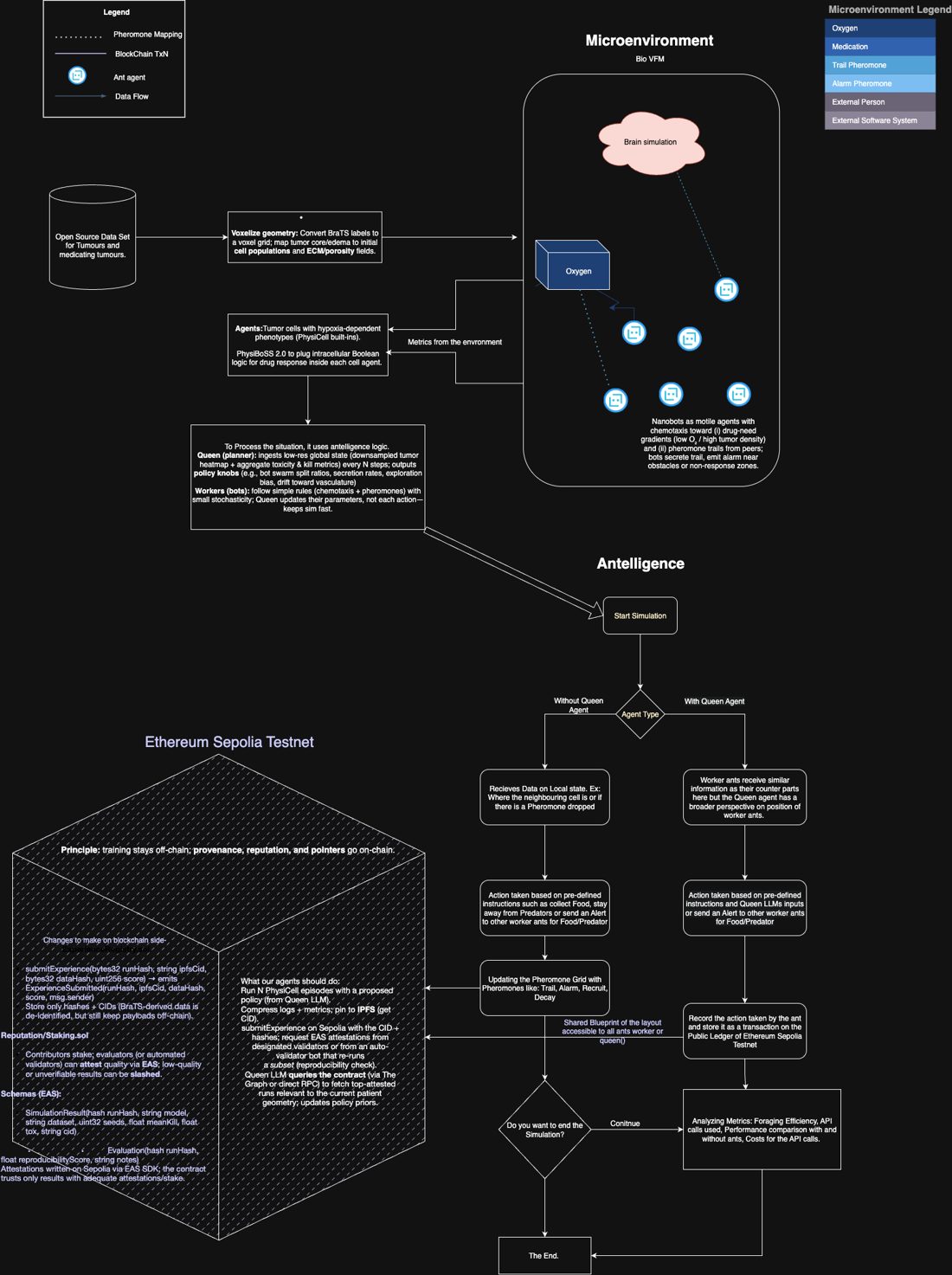
- Each simulated ant follows simple rules or asks a language model where to move next.
- Ants leave digital pheromones (scent-like markers that fade) to share trails, warnings and calls for help.
- A tumor-targeting version sends a nanobot swarm through a simulated tissue grid and measures how well it does.
- Each run's settings and results are recorded on a blockchain (a shared, tamper-evident ledger) so they can be audited.
- Cheap ESP32 robots (small hobbyist circuit boards) are the planned bridge from simulation to the physical world.
What I did
I was one of the original team of four with Kashyap Nadendla, Tanya Evita George and Zenith Mesa, and we presented posters at IEEE EMBS 2025 at UCLA and SBP-BRiMS 2025 at Carnegie Mellon. Kashyap and I kept building it, moving the on-chain layer to ZKsync for privacy and testing small open models against frontier ones inside the colony.
What I learned
Our 2026 preregistered test (a plan fixed before any runs) with matched compute showed where the gains really come from. Mixing different models added no advantage over the best single model, and the planning gains came mostly from the engine's simple model-free merge step, which tells us exactly where to invest next.